












The Differences Between Building a Marketing Strategy for a Real Estate Team vs a Solo Agent

One of the most common questions that comes up when planning a marketing strategy is if you should approach it differently if it’s a real estate team compared to a solo agent.
And the short answer is yes; that’s because the goals, the challenges, and the way your target audience perceives you are going to be different depending on whether you’re marketing yourself as an individual or as a group.
That doesn’t mean one is better than the other; it means the strategy behind each one needs to be created around how your business actually operates and what kind of experience you want people to have when they interact with your brand and your business.
The biggest mistake you can make when building a marketing strategy is assuming that a strategy built for a solo agent will work for a team, or that a strategy built for a team will work for a solo agent. To be successful, they need different approaches, different messaging, and different structures.
And understanding those differences is the first step towards building a strategy that actually reflects who you are and how you do business.
A Personal Brand vs A Team Brand
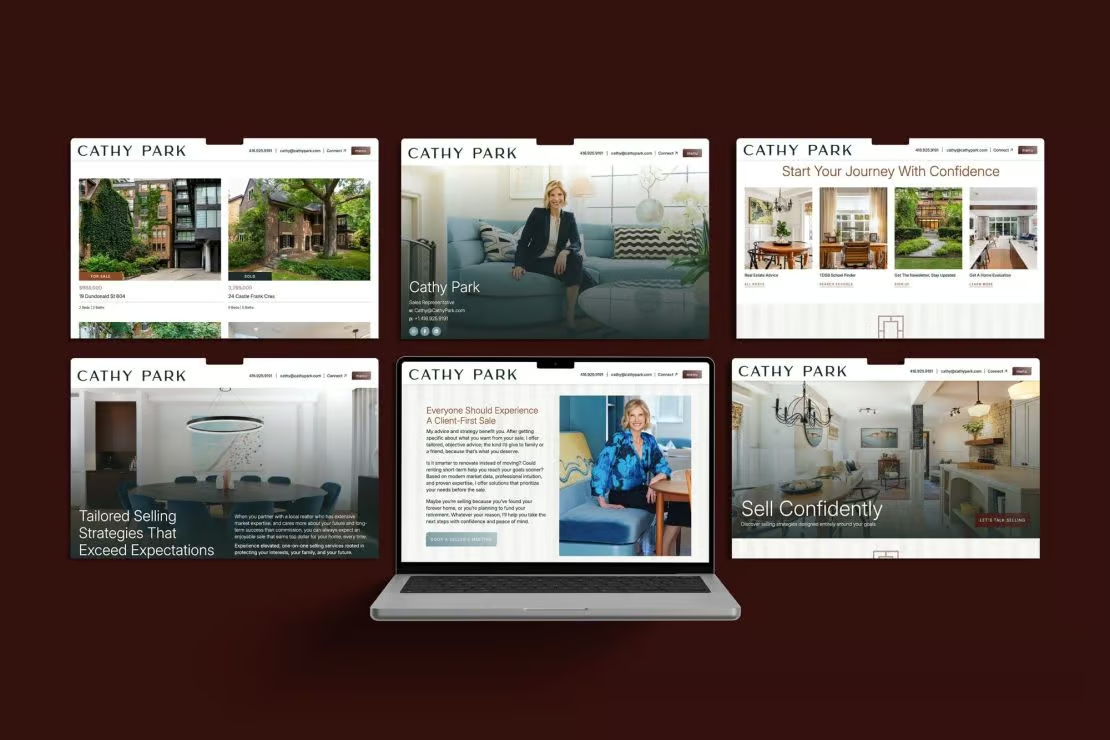
As a solo agent, your brand identity is built around you and only you. Your name, your face, your story, and your personality are the foundation of your entire marketing strategy.
When someone visits your website, they’re getting to know you as a person, and the trust they build is directly tied to who you are.
For a team, the brand identity challenge is more complex, because you have to build a brand that represents the entire team, while still showcasing the individual strengths of each team member. If you lean too far into the team brand, the individual agents can feel invisible; but if you lean too far into individual branding, the team can feel disconnected, and your audience won’t understand what the team actually stands for as a whole.
For a solo agent, brand identity is about building a personal connection. For a team, brand identity is about building a unified experience that’s bigger than any one person, while still making each person feel like a meaningful part of the story.
That means a team’s marketing strategy should work towards establishing a clear, consistent team brand with its own voice and value proposition, while positioning each team member within that brand in a way that highlights their individual expertise.
★ Want to learn more about building a brand identity? Have a look at these posts:
- Creating a Real Estate Brand Identity Visibility Strategy
- The Steps to Building a Trustworthy Personal Real Estate Brand
- Planning an End-to-End Brand Experience for Your Real Estate Business
Planning Structure and Strategy
For a solo agent, your website structure is relatively straightforward: it’s your brand, your story, your expertise, your listings, and your content. Everything on your website points back to you and is designed to build a relationship with one person.
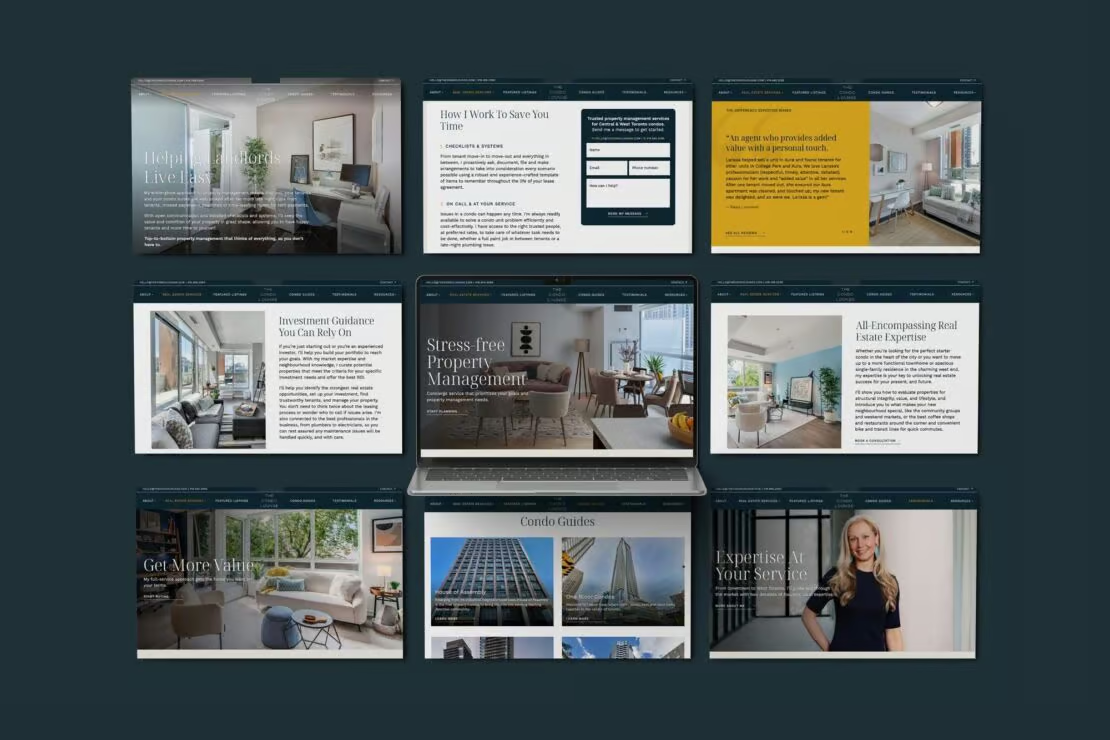
For a team, the website structure needs to do more work. It has to introduce the team as a whole, but also give each member their own presence on the site, with dedicated team member pages that go beyond just a headshot and a title. Each team member should have a page that tells their story and highlights their individual specialization.
When it comes to content strategy, the approach should also be different. A solo agent’s content can all come from one voice, which makes consistency easier. A team has an opportunity to create content from multiple perspectives and across multiple areas of expertise, which can be powerful if it’s done strategically.
For example, if one team member specializes in first-time buyers and another specializes in luxury downsizing, each of them can contribute content that targets their specific niche, and the team’s website becomes a more comprehensive resource as a result.
So while a solo agent’s content strategy is about depth in a focused niche, a larger team’s content strategy goes across multiple niches, tied together by a consistent team brand.
Generating and Assigning Leads
As a solo agent, every lead goes directly to you. There’s no question about who handles it, and the person who built the trust through the marketing strategy is the same person who shows up to the first meeting.
For a team, lead generation is more effective when it’s paired with a lead assigning strategy that matches incoming leads with the right team member, and that means the marketing strategy needs to be set up to identify what a lead is looking for before they talk to someone.
For example, if your website has dedicated pages for different services or property types, each tied to a specific team member’s expertise, you can assign incoming leads to the agent best suited to help them.
Without a lead assigning strategy, team leads can feel impersonal. If someone fills out a form expecting to work with the person whose content they’ve been reading, and they get a call from someone else entirely, that disconnect can ruin the trust that the marketing strategy worked so hard to build.
★ Want to learn more about lead generation strategy? Have a look at these posts:
- How Solving Your Audience’s Problems Gets You Higher Quality Leads
- Building a Lead Generation Strategy Through Education
- Why Slow Leads Are Better Leads (and How to Get Them)
Building an Online Presence Strategy
For a solo agent, your online presence strategy is planned around building recognition for one name and one consistent identity across every platform. Your Google Business profile, your social media accounts, your listings, and your online reviews all point to you, and the goal is to make sure that no matter where someone finds you, they see the same message and the same value proposition.
For a team, the online presence strategy needs to account for both the team’s presence and each individual member’s presence. The team should have its own Google Business profile, social media accounts, and review strategy, but each team member should also have their own individual presence that’s connected to and consistent with the team brand.
But when it comes to online reviews, that’s where a team has a significant advantage. A team can generate a higher volume of reviews across more platforms, and each review that mentions a specific team member by name adds depth that builds credibility for both the individual and the team as a whole.
A solo agent’s review strategy is about building volume and consistency for one person. A team’s review strategy is about building volume across the entire team, while making sure each review adds context about who on the team handled the transaction and what they did well.
★ Want to learn more about building an online presence and review strategy? Have a look at these posts:
- How to Build an Online Review Strategy that AI Search Can’t Ignore
- How to Build an Online Presence Strategy for Your Real Estate Brand
- How Unlinked Brand Mentions Help Your AI Visibility Strategy
The Team Advantage in AI Visibility
When it comes to AI visibility, teams have a unique advantage too: more people creating more content, generating more reviews, and building more mentions across the web, all under one larger real estate brand.
Because AI search engines, like ChatGPT and Google Gemini, rely on the depth of your online presence to determine authority, a team strategically building its presence across multiple niches and platforms has the potential to build authority faster than a solo agent can alone.
But that advantage only works if the team’s marketing strategy is intentional about it. If each team member is building their presence in isolation, without a consistent brand tying it all together, the AI won’t necessarily make the connection.
That means the key is to make sure that every piece of content, every review, and every mention ties back to the team brand while also highlighting the individual, so that AI engines understand the team is a single, authoritative entity made up of experienced, specialized professionals.
★ Want to learn more about building AI visibility? Have a look at these posts:
- Creating an AI Visibility Strategy for Your Real Estate Brand
- Building a Real Estate Online Presence Strategy to Get Found in LLMs (like ChatGPT)
- How, and Why, to Prove Your Experience to AI, LLMs, and Search Engines
The Right Strategy for the Right Structure
Whether you’re a solo agent or a team, the fundamentals are always the same: build trust, provide value, and create a meaningful experience for the people you want to work with. But the way you execute on those fundamentals should look different depending on how your business is structured.
A solo agent’s strategy should focus on building a deep, personal connection with their audience through a consistent personal brand, while a team’s strategy should focus on building a unified brand experience that’s greater than any one individual, while giving each team member the space to showcase their own expertise.
And in both cases, the strategy should be built around the understanding that your marketing isn’t just about getting leads; it’s about building a long-term, sustainable business where the right people find you, trust you, and want to work with you.
Want to get better, more qualified leads and build your authority? Our Inbound Marketing Guide is a walkthrough of the overall philosophy of inbound marketing, why it’s effective, and how you can build it into your own real estate marketing strategy to get better marketing results.