





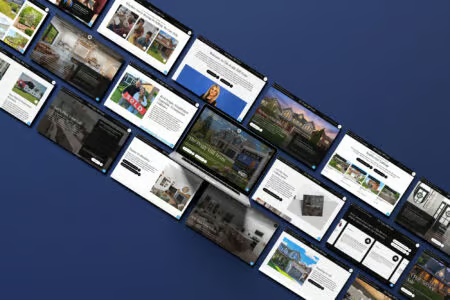




How to Know if Your Real Estate Website is Holding Your Business Back

A lot of agents don’t think about their website very often. It’s there, it’s online, it has their contact information, and it looks decent enough. So it must be working, right?
Not necessarily. There’s a big difference between having a website and having a website that’s actually doing something for your business. And for a lot of agents, especially ones who built their website a few years ago and haven’t done much with it since, the website that used to be good enough is now quietly holding them and their real estate business back.
The problem is that a website that’s underperforming doesn’t always make it known. Your traffic might look okay. Your site might still look nice. You might still get the occasional lead. But if your website isn’t keeping up with how people search, how AI platforms evaluate you, and how your competition has evolved, it’s likely costing you business you don’t even know about.
If your website isn’t actively working for your business, like attracting the right people, building trust, and generating leads, it’s not just sitting there doing nothing. It’s holding you back.
Here are the signs to look for.
Your Website Looks Like Everyone Else’s
If your website is built on a template provided by your brokerage, it probably looks like every other agent’s on the same platform. And if your website looks like everyone else’s, there’s nothing about it that sets you apart.
Your website should reflect your brand, speak to your specific target audience, and create an experience that’s uniquely yours. When a potential client visits your website, they should immediately get a sense of who you are, what you specialize in, and why you’re different from every other agent in the market.
A templated website can’t do that. It gives you the same design, the same layout, and the same limitations as every other agent using the same platform. That’s not a brand; it’s a template with your name on it.
Beyond differentiation, templated websites come with practical limitations that affect your entire digital strategy. You don’t own the site, so if you leave the brokerage or cancel the platform, it disappears along with whatever authority it’s built. You can’t customize it around your specific audience or strategy. The platform limits what you can do with SEO, content, and site structure. And your search authority is tied to a platform you don’t control.
If your website is templated, it’s not just holding your business back; it’s limiting how far your entire digital strategy can go.
★ Want to learn more about owning vs renting your website? Have a look at these posts:
- Why Real Estate Agents Should (Usually) Avoid Templated Websites
- Renting VS Buying a Real Estate Website: Why a SaaS Platform is the Wrong Choice for Agents
- Why Your Real Estate Marketing Shouldn’t Look Like Every Other Agent’s
Your Website Was Built for a Different Era
Search has changed. AI has changed how people find information and evaluate agents. Content strategy has evolved from keyword matching to topic ownership. Mobile usage has become the default. And the expectations your audience has for what a professional website should look and feel like have gone up significantly.
If your website was built more than three to four years ago and hasn’t been substantially updated since, there’s a good chance it was built for a different set of standards than what’s required today. That doesn’t mean the website was bad when it launched. It means the landscape has moved, and your website needs to move with it.
Signs that your website was built for a different era include a mobile experience that feels clunky or secondary, a site that was built around IDX property search as the centerpiece, no structured content like topic clusters or internal linking, slow load times, no consideration for AI visibility, and a design and user experience that feel dated compared to what your competitors are doing now.
Any one of those things can hold you back. A combination of them means your website is working against you, not for you.
You’re Not Showing Up in AI Search
If you, your brand, and your business aren’t showing up in AI platforms, or if the information is inaccurate, it means your online presence isn’t strong enough for AI platforms to recommend you confidently. That’s a problem that’s only going to get bigger as more people use AI as part of their research process.
The most common reason agents don’t show up in AI results is that their website doesn’t have enough original, in-depth content for the AI to work with. Thin websites, templated websites, and websites without a blog give AI platforms almost nothing to evaluate.
And if the AI doesn’t have enough information to feel confident recommending you, it won’t.
★ Want to learn more about AI visibility? Have a look at these posts:
- Creating an AI Visibility Strategy for Your Real Estate Brand
- Why You Can’t Build an AI Visibility Strategy Without a Website
- Why AI Recommends Your Competitor (And What to Do About It)
Your Website Isn’t Generating Leads
This is the most straightforward sign that you need to rethink your digital strategy. If your website isn’t producing leads, whether that’s contact form submissions, phone calls, newsletter signups, or any other measurable conversion, something isn’t working.
A website that generates leads needs several things working together. It needs the right traffic, like visitors who are part of your target audience and are searching for information relevant to what you do. It needs trust-building content, like blog posts, guides, and resources that demonstrate your expertise and help visitors with real questions. It needs clear conversion paths, like contact forms, newsletter signups, and downloadable resources that give visitors a way to reach out or stay connected. And it needs a brand experience that builds confidence, a cohesive, professional website that makes visitors feel like they’re in the right place.
If any of those pieces are missing, your website is going to underperform. And if all of them are missing, your website is essentially a placeholder that’s not contributing to your business in any meaningful way.
Your Website Doesn’t Have a Content Strategy
If your website doesn’t have a blog, or if your blog hasn’t been updated in months, your website is almost certainly underperforming.
That’s because your content strategy is a key part of your overall digital strategy. It’s how people find you through search engines. It’s what AI platforms use to understand your expertise. It’s what builds trust with your audience over time. And it’s what turns your website from a digital business card into a lead generation tool.
Without content, search engines have nothing to rank, AI platforms have nothing to cite or reference, your audience has no reason to come back, there are no entry points for new visitors to discover you, and your website can’t demonstrate expertise or build trust on any scale. It doesn’t matter how good the design is if there’s nothing behind it that gives people a reason to stay, come back, or reach out.
The agents who generate consistent leads from their website are almost always the ones with a strong, ongoing content strategy behind it. If you don’t have one, that’s one of the clearest signs that your website isn’t working as hard as it should be.
★ Want to learn more about building a content strategy? Have a look at these posts:
- Planning a Successful Content Strategy for Your Real Estate Website
- Creating an Evergreen Real Estate Content Strategy
- The Benefits of Building a Long-Form Real Estate Content Strategy
Your Traffic Has Plateaued or Declined
If your website traffic has been flat or declining for more than a few months, that’s a signal that something might need improving.
That’s because website traffic doesn’t stay the same on its own. Search algorithms evolve, your competitors publish new content, and the way people search for information changes over time. If you’re not actively investing in your content and your search strategy, your traffic will eventually start to slide, even if everything else stays the same.
There are a few common reasons this happens. Your content might be outdated and no longer relevant to what people are searching for. Your competitors might have published more comprehensive, more helpful content on the same topics. Your website’s technical health might have degraded over time, like slow load times, crawl errors, or mobile usability issues. Or you simply haven’t published new content in months, and search engines are prioritizing more recent sources.
AI platforms are also changing how it works. More and more searches are being answered directly by AI, which means some of the traffic that used to come to your site is now being captured by AI-generated responses. If your content isn’t being cited in those responses, you’re losing visibility in a channel that’s likely going to grow.
If you’re not sure whether your traffic has changed, you can start by checking your Google Analytics, and looking at the trend over the last 12 months compared to the 12 months before that. If it’s flat or down, your website isn’t keeping up.
★ Want to learn more about understanding your website’s traffic and analytics? Have a look at these posts:
- Getting a Basic Understanding of Your Real Estate Website’s Analytics
- Creating a Relevant Traffic Strategy for Your Real Estate Website
- Measuring the Success of Your Digital Strategy Through Engagement
Your Website Is Your Foundation
Your website is the foundation of your digital strategy. If the foundation isn’t strong, everything you build on top of it, like your content, your search visibility, your AI visibility, and your lead generation, will underperform.
The good news is that once you know what’s not working, you can start planning for what comes next. Whether that means a full rebuild or a significant overhaul, the goal is the same: a website that’s built to support the strategy your business needs today, not the strategy it needed three years ago.
Want to learn more about what Artifakt Digital can do and how we can help your business get ahead of the competition? Book a no-obligation consultation call with our team quickly and easily.